August 11, 2026 · 8 min read
Outdoor Fireplace vs Fire Pit: NoVA Cost 2026
By Nelson at Kaeler
Almost every outdoor living project we scope in Northern Virginia includes a fire feature, and almost every one starts with the same fork: fire pit or fireplace. The price gap between them is large enough that it reshapes the rest of the budget, so it is worth settling early and for the right reasons.
I am Nelson, owner of Kaeler. The short version is that they are not competing versions of the same thing. A fire pit is a gathering point. A fireplace is a wall with a fire in it — it defines an outdoor room, blocks wind and sightlines, and anchors a space architecturally. Which one you want depends on what the yard is missing, not on which is nicer.
Cost at a glance in NoVA 2026
| Feature | Installed cost | Build time | Lifespan |
|---|---|---|---|
| Pre-fab fire pit kit, wood-burning | $1,400 – $3,200 | 1 day | 15 – 25 yrs |
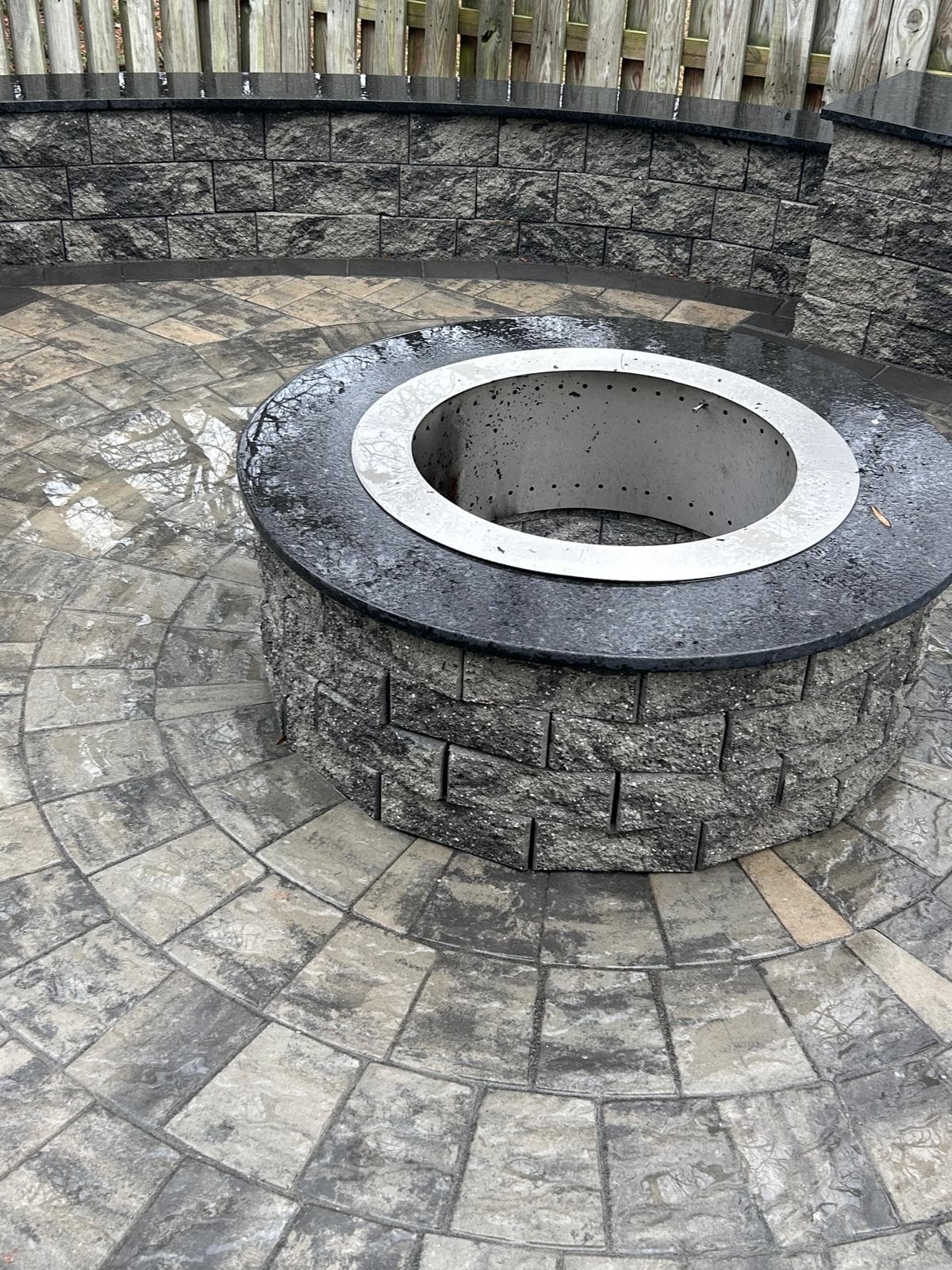
| Custom masonry fire pit, wood-burning | $3,400 – $7,500 | 2 – 3 days | 30 – 50 yrs |
| Gas fire pit, natural gas line run | $4,800 – $11,000 | 3 – 5 days | 25 – 40 yrs |
| Gas fire table, propane, no line | $2,200 – $5,000 | 1 day | 15 – 20 yrs |
| Outdoor fireplace, wood-burning masonry | $9,500 – $24,000 | 2 – 4 weeks | 50 – 80 yrs |
| Outdoor fireplace, gas | $12,000 – $30,000 | 3 – 5 weeks | 50 – 80 yrs |
| Fireplace with seat walls and hearth surround | $18,000 – $45,000 | 4 – 6 weeks | 50 – 80 yrs |
Premium markets — McLean, Great Falls, Fairfax Station — run 15 to 25% above these, mostly on stone selection and mason labour.
What drives fire pit cost
Fuel. Wood is cheapest to build and cheapest to run, and it is what most NoVA homeowners actually want. Natural gas costs the most to install because someone has to trench and run a line from the meter, but it lights instantly and produces no smoke, which matters more than people expect on a small lot with close neighbours. Propane sits in between and needs somewhere to hide the tank.
Construction. A pre-fab kit is a steel or concrete insert with a veneer around it. Custom masonry is built course by course with a firebrick liner. The kit is fine, and on a modest budget it is the right call — but it will read as a kit next to a custom patio.
Gas line distance. The single biggest swing on a gas pit. A run from the meter of 20 feet is a different job from 80 feet across a finished patio. Trenching runs $28 – $55 per linear foot in NoVA, and it goes up sharply if it has to cross existing hardscape.
Seating integration. A fire pit surrounded by moveable chairs is one number. A fire pit with a built-in curved seat wall is $3,200 – $8,500 more, and it is usually what makes the space feel finished.
What drives fireplace cost
The chimney. This is most of the difference. A code-compliant outdoor fireplace needs a proper firebox, throat, smoke chamber, and flue, and the chimney has to clear surrounding structures. It is a mason's job measured in weeks, not days.
Foundation. A masonry fireplace weighs several tons. It needs a reinforced concrete footing below frost depth, which in Northern Virginia means 24 to 30 inches. That footing has to be poured and cured before any stone goes up.
Stone selection. Cultured stone veneer runs $18 – $32 per sq ft installed. Full natural stone runs $38 – $75. On a fireplace face plus chimney that difference compounds fast.
Extras. A wood box, a raised hearth, a mantel, a TV chase, and flanking seat walls each add $1,200 – $6,000. They are also what turns a fireplace into an outdoor room rather than a feature.
How each one changes the way a yard gets used
This is the part that price lists miss.
| Fire pit | Fireplace | |
|---|---|---|
| Seating shape | Circular, everyone faces in | Linear, everyone faces one direction |
| Group size it suits | 6 – 10 | 4 – 6 comfortably |
| Conversation | Everyone in one conversation | Splits into pairs |
| Wind and privacy | No help | Blocks both |
| Defines a room | No | Yes |
| Season extension | Adds roughly 6 – 8 weeks | Adds roughly 10 – 14 weeks |
| Footprint required | 12 – 16 ft circle | 8 – 12 ft of wall plus seating depth |
| Works on a small lot | Yes | Only if the yard has a natural back edge |
If the goal is hosting groups, a fire pit does it better and costs a quarter as much. If the goal is a defined outdoor room with privacy from a neighbour, no fire pit substitutes for a fireplace.
Code and clearance in Northern Virginia
Clearances are where projects get redesigned late, so check them before you fall in love with a location.
- Distance from structures. Most NoVA jurisdictions require a wood-burning fire feature to sit at least 10 feet from any structure, and further from a combustible overhang. Confirm with your locality — the number is not uniform across the region.
- Distance from property lines. Typically 5 to 10 feet, and HOAs frequently set stricter limits than the county does.
- Overhead clearance. No branches, no pergola roof, no soffit above a wood-burning feature. This one kills more designs than any other.
- Permits. A ground-level fire pit generally does not need a permit. A masonry fireplace with a chimney generally does, and a gas line always does — the gas work requires a licensed installer and an inspection regardless of who builds the feature.
- Burn restrictions. Some HOAs prohibit wood-burning outright. It is worth reading your covenant before you scope a wood-burning build.
If you are already navigating county paperwork for other hardscape, our Fairfax County retaining wall permit guide covers how the process runs in practice.
Which one, given your situation
| Situation | Choose | Reasoning |
|---|---|---|
| Under $5,000 total | Fire pit, custom masonry | Best result available in that range |
| Hosting 8+ people regularly | Fire pit | Circular seating, one conversation |
| Small lot, close neighbours | Gas fire pit | No smoke complaints, instant off |
| Yard needs a privacy edge | Fireplace | The wall is the point |
| Already have a large patio | Fireplace | It gives the space a focal wall |
| Want the longest season | Fireplace | Radiant heat off a mass wall carries further |
| Resale is the driver | Fire pit | Better return per dollar spent |
| Existing outdoor kitchen | Fireplace | They read as one built room together |
On the resale point specifically: fire features return well, but not evenly. The full picture for NoVA is in our outdoor kitchen ROI analysis for McLean and Vienna and the Springfield hardscaping ROI data.
The mistakes we see most
- Putting the fire pit in the middle of the patio. It permanently occupies the space you need for a dining table. Push it to a defined zone at the edge, or build the patio large enough to hold both.
- Sizing the pit too large. A 48-inch interior diameter throws more heat than most people want and pushes the seating circle out to 16 feet. 36 to 42 inches suits most NoVA yards.
- Skipping the firebrick liner on a masonry pit. Standard block spalls under repeated heat. The liner is a few hundred dollars and it is the difference between 15 years and 40.
- Running gas later. Trenching a line across a finished patio means lifting and resetting it. If gas is even possible in the future, sleeve for it during the patio build.
- Building a fireplace against the prevailing wind. In NoVA that is generally from the northwest. A fireplace facing into it smokes back at the seating every time.
Frequently asked questions
How much does a fire pit cost in Northern Virginia?
A pre-fab kit runs $1,400 – $3,200 installed. Custom masonry runs $3,400 – $7,500. A gas fire pit with a natural gas line runs $4,800 – $11,000, with the line distance driving most of that range.
Is an outdoor fireplace worth the extra cost over a fire pit?
It is worth it when you need what only a fireplace provides — a wall that blocks wind and sightlines and defines an outdoor room. As a pure heat source and gathering point, a fire pit does the job at roughly a quarter of the cost.
Do I need a permit for a fire pit in Fairfax County?
A ground-level wood-burning fire pit generally does not require a permit, though clearance rules still apply. A masonry fireplace with a chimney generally does, and any natural gas line requires a permit and a licensed installer regardless of the feature.
Gas or wood-burning for a NoVA backyard?
Gas if you have close neighbours, want it lit in thirty seconds, or dislike managing smoke and ash. Wood if you want the fire itself to be part of the experience and want to spend less on installation. Gas costs more up front and less in effort.
How far does a fire feature have to be from the house?
Most NoVA jurisdictions set 10 feet as the minimum for wood-burning features, with additional clearance required from combustible overhangs. Property line setbacks typically run 5 to 10 feet, and HOA rules are often stricter than the county's.
Can a fire pit be added to an existing patio?
Yes. A surface-set pre-fab or custom pit installs on top of an existing patio with no excavation. The complication is only gas — running a line to a pit on a finished patio means lifting a channel of pavers and resetting them afterward.
Scope your fire feature on the actual site
Clearances, wind direction, and gas line distance all get decided by the property, not by the catalogue. That is a fifteen-minute conversation standing in the yard.
Book a free site visit and we will walk the locations that work, tell you what each option costs on your lot, and send it in writing within 48 hours.
We build fire features across Great Falls, McLean, Fairfax Station, Vienna, and the rest of the 18 NoVA cities we serve.