August 21, 2026 · 7 min read
Walkway Cost: Flagstone, Paver, or Concrete
By Nelson at Kaeler
A front walkway is the smallest hardscape project most homeowners take on and the one with the highest visibility per dollar. It is the first thing a visitor walks on and the first thing in a listing photo. It is also the project where the quote range surprises people most — the same 60-foot walk can price anywhere from $2,900 to $13,500 depending on material and width.
I am Nelson, owner of Kaeler. Here is what walkways actually cost in Northern Virginia in 2026, and what moves the number.
Cost per square foot, installed
| Material | 2026 NoVA installed cost | Lifespan | Repairable |
|---|---|---|---|
| Poured concrete, broom finish | $12 – $20 /sq ft | 25 – 40 yrs | Patch only, visible |
| Stamped concrete | $18 – $30 /sq ft | 25 – 40 yrs | Difficult to match |
| Concrete pavers | $19 – $32 /sq ft | 30 – 50 yrs | Yes, unit by unit |
| Flagstone, dry-laid | $28 – $46 /sq ft | 50 – 100 yrs | Yes |
| Flagstone, mortared on slab | $34 – $58 /sq ft | 40 – 75 yrs | Difficult |
| Brick, clay | $24 – $40 /sq ft | 50 – 100 yrs | Yes |
A typical front walk of 60 linear feet at 4 feet wide is 240 sq ft:
| Material | Typical total |
|---|---|
| Poured concrete | $2,880 – $4,800 |
| Stamped concrete | $4,320 – $7,200 |
| Concrete pavers | $4,560 – $7,680 |
| Dry-laid flagstone | $6,720 – $11,040 |
| Mortared flagstone | $8,160 – $13,920 |
Premium markets — McLean, Great Falls, Vienna — run 15 to 25% above these on stone work specifically, where mason labour is the constraint.
The width decision is bigger than people expect
Width scales the whole project linearly, and most existing NoVA walks are too narrow.
| Width | Use | Cost impact on 60 ft |
|---|---|---|
| 3 ft | Single file only. Common on older builds, feels cramped | Baseline |
| 4 ft | Two people can pass, one at a time comfortably | +33% |
| 5 ft | Two people walk side by side | +67% |
| 6 ft | Grand front approach, suits larger homes | +100% |
Four feet is the practical minimum for a front walk on a house of any size. Five feet is what makes an approach feel generous, and on a larger Vienna or Oakton home the difference between 4 and 5 feet does more for how the house presents than upgrading the material would.
What each material is actually good at
Poured concrete is the cheapest durable option and it is honest about what it is. On a modern or mid-century house a clean broom-finish walk looks right. Its weakness in NoVA is freeze-thaw: concrete cracks, and a cracked slab cannot be repaired invisibly. Control joints help; they do not eliminate it.
Stamped concrete buys the look of stone at concrete prices, and it works from a distance. Up close it repeats — the same stamp pattern rotating every few feet — and once it cracks or the colour wears, matching a repair is close to impossible. We recommend it where budget is fixed and the walk is long.
Concrete pavers are the balanced choice, and the reason is repairability. A paver walk moves with frost instead of cracking, and any single damaged unit lifts out and gets replaced. Thirty to fifty year lifespan, wide style range, and a settled section can be reset rather than rebuilt. For most NoVA front walks this is where we land.
Flagstone is the premium answer and it is genuinely different in person — irregular natural stone, no repeat pattern, and it improves with age. Dry-laid on a proper base is our preference over mortared on a slab, because dry-laid moves with the freeze-thaw cycle and can be relaid, while mortared flagstone cracks at the joints when the slab beneath it moves. Mortared looks crisper on day one and ages worse here.
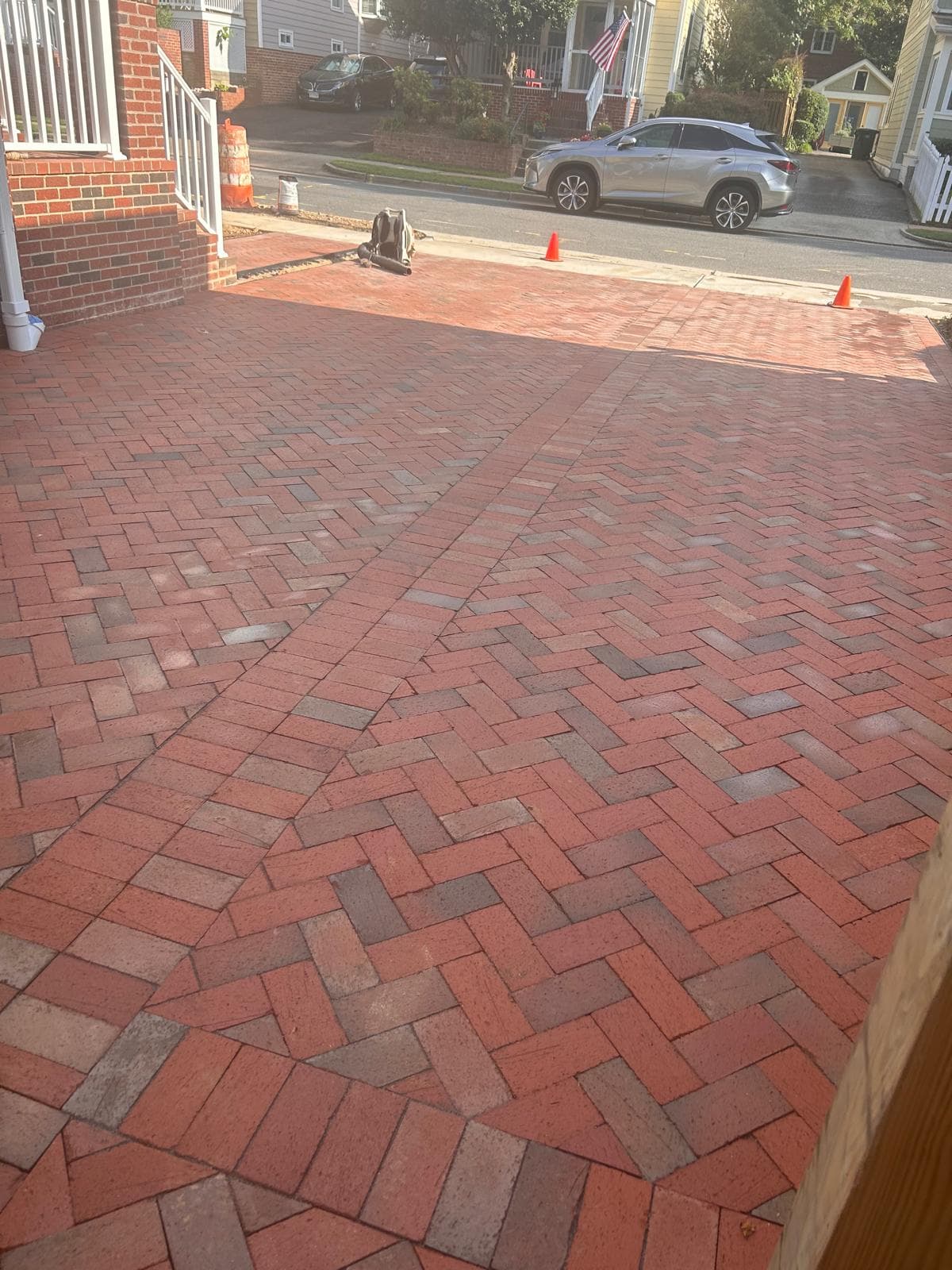
Clay brick suits colonial and traditional NoVA architecture better than anything else, and it holds its colour permanently because the colour is the material rather than a pigment. Herringbone laid on a compacted base is effectively permanent. It is also less forgiving of an uneven base than any other option.
For how the same materials behave on a driveway, where vehicle load changes the calculation entirely, see our driveway material comparison.
The base is the same story as a patio
Everything that decides whether a patio lasts decides whether a walkway lasts, at smaller scale:
- 4 to 6 inches of compacted crushed aggregate for pedestrian walks on NoVA clay. Placed in lifts, compacted each lift.
- Geotextile fabric between clay subgrade and base stone, to stop the clay migrating up into the aggregate over the years.
- Edge restraint on both sides of a paver or brick walk. Walkways are almost entirely perimeter, so this matters even more here than on a patio.
- Pitch away from the house — a quarter inch per foot minimum. A walk that pitches toward the foundation delivers water exactly where you least want it.
A quote that omits base depth is the same warning sign on a walkway as on a patio. Our piece on the top five patio mistakes covers what those omissions cost.
Things worth adding while the walk is open
Once the trench is dug and the base is being set, several upgrades cost a fraction of what they cost later:
| Addition | Cost during install | Cost retrofitted |
|---|---|---|
| Low-voltage lighting conduit | $4 – $9 /linear ft | $14 – $28 /linear ft |
| Landscape lighting fixtures | $110 – $280 each | Same, plus trenching |
| Wider landing at the front door | $400 – $1,400 | Rebuild the approach |
| Step rebuild to match | $900 – $3,200 | Higher, plus mismatch risk |
| Drainage tie-in from downspout | $300 – $800 | $900 – $2,200 |
The lighting conduit is the one to take. It is cheap while the ground is open and it means you can add lighting any time in the next twenty years without touching the walk.
When to replace versus repair
| Symptom | Likely cause | Repair or replace |
|---|---|---|
| One or two settled pavers | Localised base issue | Repair, lift and reset |
| Concrete cracked in one place | Missing or failed control joint | Repair, though it will show |
| Concrete cracked in several places | Base failure or no base | Replace |
| Flagstone joints opening | Normal on dry-laid | Repair, re-sand |
| Mortared flagstone cracking at joints | Slab beneath is moving | Replace |
| Walk pitches toward the house | Original grading error | Replace |
| Trip lip over half an inch | Root heave or settlement | Repair if isolated, replace if general |
The one on that list to act on quickly is the trip lip. It is a liability question as much as a maintenance one.
Frequently asked questions
How much does a walkway cost in Northern Virginia?
A typical 60-foot front walk at 4 feet wide runs $2,880 – $4,800 in poured concrete, $4,560 – $7,680 in concrete pavers, and $6,720 – $11,040 in dry-laid flagstone. Width scales the total directly, so a 5-foot walk is roughly a quarter more than a 4-foot one.
What is the best walkway material for NoVA?
Concrete pavers for most homeowners, because they handle freeze-thaw by moving rather than cracking, and any damaged unit can be replaced individually. Flagstone is the premium choice and clay brick suits traditional architecture better than anything else.
How wide should a front walkway be?
Four feet is the practical minimum for a house of any size, and five feet lets two people walk side by side. Most older NoVA walks are three feet, which is why widening frequently does more for how a house presents than changing the material.
Is stamped concrete a good idea in Northern Virginia?
It works where budget is fixed and the run is long, but it has two real weaknesses on our freeze-thaw cycle: it cracks like any slab, and repairs cannot be colour-matched to the original stamp. Pavers cost modestly more and avoid both problems.
Can a walkway be installed over an existing concrete path?
Sometimes. Pavers or flagstone can be mortared onto a sound slab, but only if the slab is stable, uncracked, and the added height does not create a step at the door threshold. If the slab is already cracking, overlaying it just moves the crack upward within a few seasons.
How long does a walkway installation take?
Two to four days for a typical front walk in pavers or concrete. Flagstone takes four to seven days because each stone is fitted individually. Concrete needs a further seven days of cure before heavy use, though it can be walked on much sooner.
Get your walk measured and quoted
Width, base depth, and pitch decide whether a walkway still looks right in fifteen years, and all three get settled in one visit.
Book a free site visit and we will measure the run, check the pitch away from the foundation, and put material options side by side in writing within 48 hours.
We build walkways across Fairfax, Falls Church, Vienna, Springfield, and the rest of the 18 NoVA cities we serve.