August 8, 2026 · 10 min read
Retaining Wall Materials: Block, Stone, Timber or Concrete
By Nelson at Kaeler
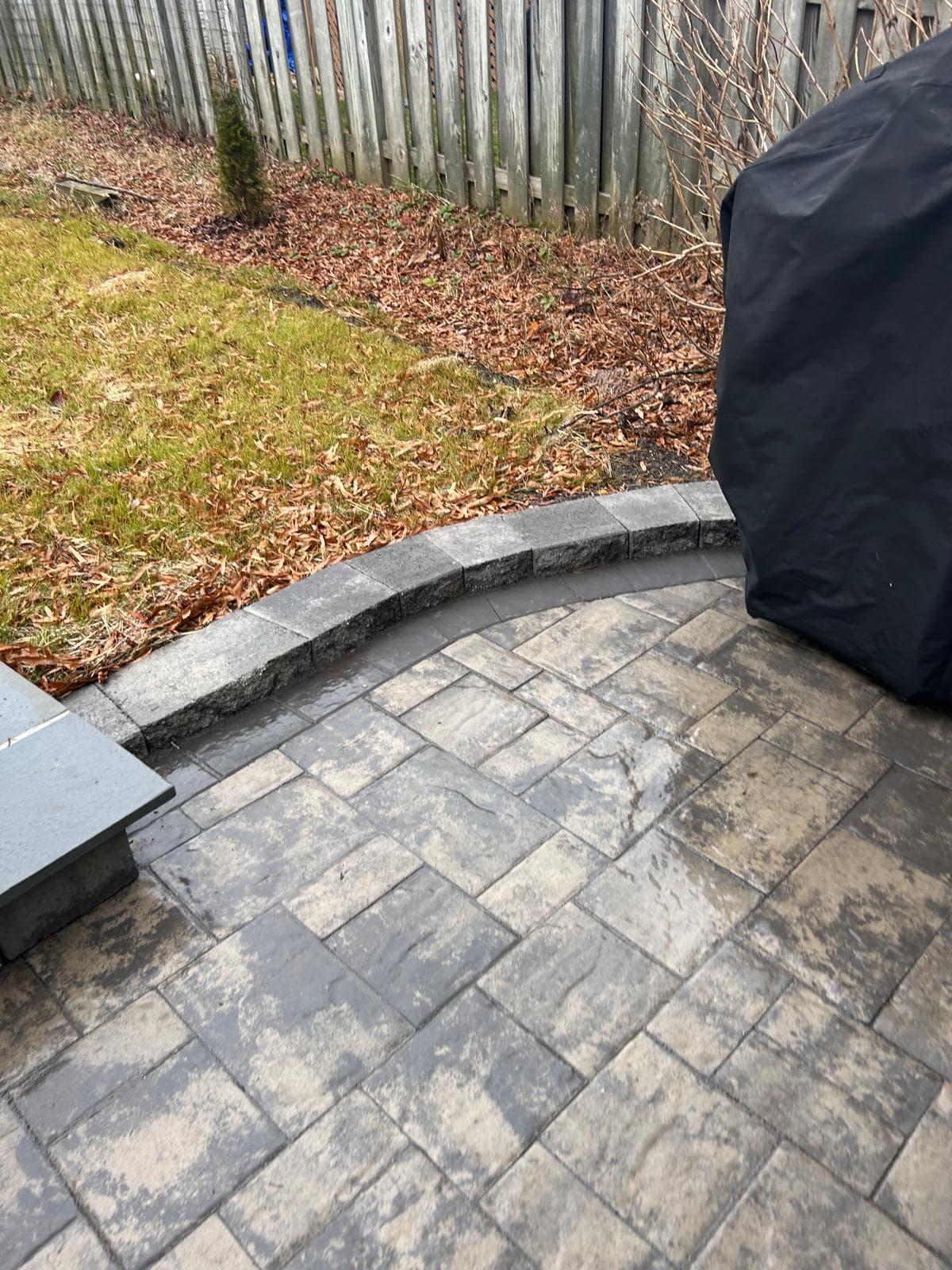
A retaining wall is one of the highest-stakes decisions on a Northern Virginia property. Built right, it holds grade for 50 to 100 years, stops erosion, and hands you usable yard. Built wrong, it bulges, then leans, then comes down — and a rebuild in Fairfax, Burke, McLean, or Springfield routinely costs two to three times the original install.
I am Nelson, owner of Kaeler. This guide is about the material decision specifically: the four options we build with in NoVA, how long each actually lasts on our clay, and which one fits which situation. If what you need first is the number, our retaining wall cost breakdown for Springfield and Burke covers pricing by wall size in detail.
First: do you actually need a wall?
Before spending money on a wall, confirm one is the right tool. A wall earns its cost when:
- The slope is steeper than 3:1 and you want flat usable space above or below it
- Erosion is actively damaging yard, driveway, or foundation
- You are cutting into a hillside for a patio, pool, or addition
- You want a tiered planting design or terraced seating
- Tree roots and surface water have made a slope unstable
A wall is the wrong tool when a swale or terraced planting would solve the drainage for less, when the slope is mild and stable, or when the goal is purely cosmetic and edging would do. Plenty of homeowners in Burke and Lorton come to us asking for a wall and leave with a graded swale and terraced plantings instead, $4,000 to $8,000 lighter than the wall they came in for.
The four materials we build with in NoVA
Segmental concrete block — the default
Pre-cast blocks that interlock without mortar, 40 to 90 lbs each. Brands you will see quoted here: Versa-Lok, Allan Block, Anchor, Belgard, Techo-Bloc, Cambridge.
Best for: walls 2 to 8 feet, curves, tiered designs, mid-budget projects. 2026 NoVA installed cost: $35 – $65 per face square foot. Lifespan: 50 – 75 years when installed correctly.
| Wall size | Typical installed cost |
|---|---|
| 30 ft long x 2 ft tall (60 sq ft face) | $2,100 – $3,900 |
| 50 ft long x 3 ft tall (150 sq ft face) | $5,250 – $9,750 |
| 80 ft long x 4 ft tall (320 sq ft face) | $11,200 – $20,800 |
| 100 ft long x 6 ft tall (600 sq ft face, engineered) | $24,000 – $42,000 |
It wins on predictability: wide colour and texture range, the strongest engineered systems for tall walls, and individual blocks can be replaced if one gets damaged. It loses on character — basic block patterns read repetitive — and the joints collect debris over decades. The bigger caveat is that block wall quality depends almost entirely on the installer, which is the subject of the last section here.
Natural stone — the premium option
Bluestone, fieldstone, granite, limestone, sandstone. Two sub-types matter: dry-stacked, where a mason fits stones without mortar, and mortared, which is faster and slightly cheaper but locks the wall and limits future repair.
Best for: premium projects in McLean, Great Falls, and Vienna, and restoration work where the wall has to match an existing built environment. 2026 NoVA installed cost: $55 – $130 per face square foot. Lifespan: 75 – 150+ years with proper drainage.
| Wall size | Dry-stacked | Mortared |
|---|---|---|
| 30 ft x 2 ft (60 sq ft face) | $4,800 – $7,800 | $3,300 – $5,400 |
| 50 ft x 3 ft (150 sq ft face) | $12,000 – $19,500 | $8,250 – $13,500 |
| 80 ft x 4 ft (320 sq ft face) | $25,600 – $41,600 | $17,600 – $28,800 |
Stone looks better with age, drains naturally when dry-stacked, and carries real resale weight in premium NoVA markets. It also needs an actual mason rather than a general crew, takes one and a half to three times as long to build as block, and above about 6 feet usually needs a hidden block core to carry the engineering.
Pressure-treated timber — the budget option we mostly steer away from
6x6 or 8x8 pressure-treated lumber stacked horizontally, pinned with rebar and anchored with dead-men.
Best for: walls under 4 feet, low-stakes or temporary installs, rural-style properties. 2026 NoVA installed cost: $22 – $40 per face square foot. Lifespan: 15 – 25 years.
| Wall size | Typical installed cost |
|---|---|
| 30 ft x 2 ft (60 sq ft face) | $1,320 – $2,400 |
| 50 ft x 3 ft (150 sq ft face) | $3,300 – $6,000 |
| 80 ft x 4 ft (320 sq ft face) | $7,040 – $12,800, where the jurisdiction allows it |
Timber is the cheapest thing to put up and the most expensive thing to own. You will replace it inside your own ownership of the house. Several NoVA jurisdictions cap timber walls at 3 to 4 feet. Damaged sections rarely repair cleanly — you generally rebuild. My honest recommendation in 2026: skip timber for anything visible or load-bearing. Once you price the replacement, the gap to segmental block closes entirely.
Poured concrete — engineered and structural
Steel-reinforced concrete poured in place, often faced with stone veneer.
Best for: walls over 8 feet, structural loads, steep driveway walls in McLean and Great Falls. 2026 NoVA installed cost: $65 – $150+ per face square foot. Lifespan: 75 – 100+ years.
| Wall size | Typical installed cost |
|---|---|
| 30 ft x 4 ft (120 sq ft face) | $7,800 – $18,000 |
| 50 ft x 6 ft (300 sq ft face) | $19,500 – $45,000 |
| 80 ft x 8 ft (640 sq ft face) | $41,600 – $96,000 |
Strongest material, lowest long-term maintenance, and it takes veneer so it can match any aesthetic. It is also the most expensive up front, requires engineering and permits at essentially any height, and the build itself is disruptive — trucks, formwork, rebar. Veneer adds another 30 to 60% on top.
Matching material to situation
| Your situation | Material | Why |
|---|---|---|
| Mid-budget residential, 2 – 4 ft | Segmental block | Best cost-to-longevity ratio available |
| Premium home, curb appeal drives the decision | Dry-stacked natural stone | Resale, aesthetic, and lifespan all align |
| Tight budget, under 3 ft, short horizon | Timber | Cheapest, accepting a 15-year life |
| Over 6 ft or carrying structural load | Poured concrete, usually veneered | Strongest, and code requires engineering anyway |
| Historic district restoration | Mortared stone matching the original | Has to read as part of the existing fabric |
| Tiered design, several short walls | Block or dry-stacked stone | Both terrace cleanly |
| Around a pool or patio | Whatever the patio already uses | Visual consistency beats variety here |
What drives price beyond the material
Material is one of five cost drivers. The others move the number just as much.
Height. Cost per face square foot climbs with height because walls over 4 feet need engineering ($800 – $2,500), permits, a reinforced base, geogrid layers every 16 to 24 inches, and more backfill stone. A 6-foot wall is not 1.5x a 4-foot wall — it is usually 2x to 2.5x.
Drainage. The most ignored line item and the number one cause of wall failure in NoVA clay. Drainage stone behind the full wall runs $400 – $1,800, base drain pipe with a daylight outlet $300 – $800, and geotextile fabric $200 – $500. Budget $900 – $3,100 and do not cut it. Walls fail from water pressure, not from the weight of the soil. The same physics drives everything in our clay soil drainage guide.
Access. Front-yard drivable access is the baseline. A gated backyard adds around 10%. No machinery access at all adds 25 to 50%. Rocky soil or buried obstacles add $1,500 – $5,000.
Geogrid. Above 4 feet, blocks alone are not enough. Polymer mesh gets buried in the backfill and tied into the wall every 16 to 24 inches of height. Adds $4 – $8 per face square foot.
Engineering and permits.
| Wall type | Engineering | Permit | Typical total |
|---|---|---|---|
| Block under 4 ft | None | None | $0 |
| Block 4 – 6 ft | $800 – $1,500 | $200 – $600 | $1,000 – $2,100 |
| Block or stone over 6 ft | $1,500 – $3,000 | $400 – $900 | $1,900 – $3,900 |
| Poured concrete, any height | $2,000 – $5,000 | $500 – $1,200 | $2,500 – $6,200 |
Our Fairfax County retaining wall permit guide walks the county process itself.
The five mistakes that destroy retaining walls
We get called every year to fix somebody else's wall. It is nearly always one of these five.
- No drainage stone or fabric. Water builds behind the wall, pushes it forward, and the wall leans then fails. This is the most common failure we see in NoVA, by a wide margin.
- Inadequate base prep. A wall needs 6 to 12 inches of compacted clean stone, levelled within an eighth of an inch. Rush it and you get uneven settling inside five years.
- No geogrid above 4 feet. The face looks fine for about five years, starts bulging around year ten, and is leaning by year fifteen.
- Bury depth too shallow. The first course should be buried one inch for every foot of wall height, minimum six inches. Surface-set walls fail at the bottom course first.
- No cap, or a cap that is only stacked. Without a proper capped top, water gets into the block voids, freezes, and cracks the top course over a few winters. Caps belong glued with masonry adhesive.
How to vet a wall contractor
Ask these before you sign anything:
- Show me your last three retaining walls in this area. Then go drive by them. If they cannot produce three, that is your answer.
- What is your base prep specification? You want to hear something specific, like six inches of compacted clean stone.
- What drainage system is included? Drainage stone, perforated pipe with a daylight outlet, and geotextile fabric should all be named.
- At what height do you use geogrid? "Anything over four feet" is the correct answer.
- Are you licensed and insured? Ask for the certificate, not a verbal yes.
- Who pulls the permit? They should.
- What is the workmanship warranty? Two years minimum on the structure, five is better.
Frequently asked questions
Which retaining wall material lasts longest?
Natural stone and poured concrete both last 75 to 100+ years. Segmental concrete block lasts 50 to 75 years. Pressure-treated timber lasts 15 to 25 years, which is why we rarely recommend it for anything permanent.
What material gives the best value in Northern Virginia?
Segmental concrete block, for most residential walls between 2 and 8 feet. It carries the best cost-to-lifespan ratio of the four, handles curves and tiers, and the engineered systems scale to tall walls when needed.
Do I need a permit for a retaining wall in Fairfax County?
Walls over 4 feet, measured from the bottom of the footing to the top of the wall, require a permit and engineered drawings in Fairfax County and most NoVA jurisdictions. Walls under 4 feet generally do not, but HOA rules and your specific locality can still apply.
Can natural stone be used on a tall wall?
Yes, but above roughly 6 feet a stone wall usually gets a hidden segmental block core doing the structural work, with the stone as the visible face. Pure dry-stacked stone at that height is difficult to engineer and rarely the economical choice.
Can I build a retaining wall myself?
A decorative block wall under 2 feet is a reasonable DIY project. Anything taller, holding real load, or near a structure or driveway needs proper engineering, drainage, and geogrid. Failed walls average $8,000 – $25,000 to rebuild, well above what the original install would have cost done right.
How long does installation take?
A typical residential wall takes 3 to 10 working days depending on length, height, and access. Larger engineered walls run 2 to 4 weeks. Stone takes longer than block. Excavation, base prep, and drainage consume most of the schedule — the visible stacking is the fast part.
Get your wall scoped before you pick a material
The material decision usually settles itself once someone has stood on the slope, checked the soil, and measured the grade change. That visit is free.
Book a free site visit and we will walk the wall line with you, tell you which materials the site actually supports, and put the options in writing within 48 hours.
We build retaining walls across Springfield, Burke, Annandale, Fairfax Station, and the rest of the 18 NoVA cities we serve.