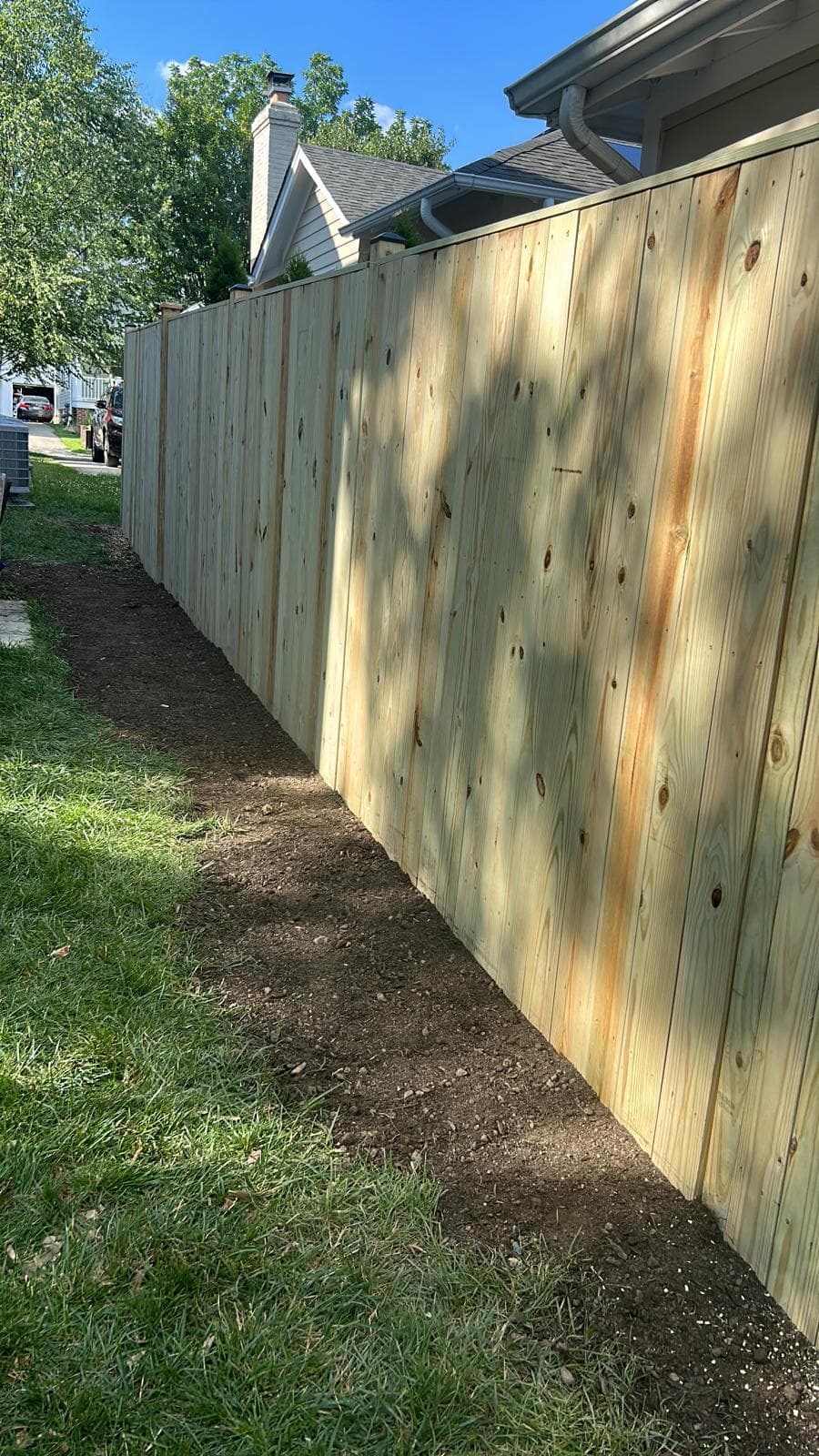
The single most common reason a fence gets torn down within a year of install in Fairfax County is not a property line dispute. It is a setback violation that the contractor either did not know about or hoped the inspector would miss. The 2026 Fairfax County zoning ordinance gives the county the authority to require removal, and the cost falls on the homeowner — not the contractor.
This is the Kaeler 2026 breakdown of fence permits, height limits, setback rules, HOA review, and the four mistakes we see most often when homeowners hire a fence crew that does not do the permit work themselves.
The short answer: do you need a fence permit in Fairfax County?
| Scenario | Permit required (2026)? |
|---|---|
| Fence under 7 ft tall, conforming to setbacks | No |
| Fence 7 ft tall or higher | Yes |
| Fence on a corner lot (visibility triangle) | Yes |
| Fence within an easement | Yes |
| Fence as part of a pool enclosure | Yes — pool safety code |
| Fence on a recorded conservation area | Yes |
| Fence in an HOA-managed community | HOA approval required (separate from county) |
Most residential fences in Fairfax County (under 7 feet, on a clean residential lot, not on a corner or easement) do not require a building permit. They still need to comply with setback, height, and HOA rules — and a property survey is the only way to confirm.
Fairfax County 2026 fence height rules
The Fairfax County zoning ordinance sets height limits based on where the fence sits on the lot.
| Lot zone | Max height (2026) |
|---|---|
| Front yard (between street and the front building line) | 4 ft |
| Side yard | 7 ft |
| Rear yard | 7 ft |
| Corner lot — side facing street | 4 ft within sight triangle |
| Within a 35 ft sight triangle at intersections | 3 ft |
The most-violated rule we see is the front-yard 4-foot limit. Many homeowners install a 6-foot fence along the side of the house that runs into the front yard. Once any portion of the fence crosses in front of the house's front building line, that portion has to drop to 4 feet.
Setbacks and property lines
Fairfax County does not require a fence to sit a specific distance from the property line — you can build to the line. But:
- Building to the line means you cannot maintain the back side of the fence from your own yard. Either you set the fence back 12–18 inches, or you negotiate access with the neighbor in writing.
- An easement may run across the property line. Drainage easements, utility easements, and sewer easements all restrict what can be built. A 2026 plat survey is the only way to confirm. Easements typically cost $400–$1,100 to pull a current survey for.
- HOA review takes precedence over county rules on private property. A 7-foot fence allowed by Fairfax County may be denied by an HOA architectural review board.
For more on HOA dynamics around fencing specifically — covenants that override the county code, approved materials, and architectural review timelines — see our guide to privacy fences in Vienna and Falls Church.
When you DO need a permit
A building permit is required in 2026 when any of the following apply:
- Height over 7 feet. Including decorative elements like post caps, lattice toppers, and trellis additions.
- Fence is part of a pool enclosure. Pool barriers in Virginia must meet specific code (48-inch minimum height, self-closing gates, no climbable elements within 36 inches of the top). The pool permit usually includes the fence.
- Fence sits within a setback that requires variance. Most setback issues are resolved by re-siting the fence; variance is required only if the setback cannot be avoided.
- Fence within a conservation overlay district. Some parts of Fairfax County (around streams, wetlands, and floodplains) have additional restrictions.
- Corner-lot side yard fencing inside the visibility triangle. This is height-restricted, not always permit-required — but check.
Fence permits in Fairfax County in 2026 cost $120–$280 plus inspection time. Same-week processing is common for clean applications.
When you do NOT need a permit (but still need to do it right)
For the typical Fairfax County rear-yard or side-yard wood, vinyl, or aluminum fence:
- No permit required if under 7 feet
- No permit required if outside easements
- Still need property survey or recorded plat to confirm property lines
- Still need HOA approval if the lot is in a covenanted community
We pull a property survey on every fence install where the property line is in question. The $400–$800 survey is cheap insurance against a $7,000 tear-down.
HOA approval (the hidden permit)
Every major Fairfax County HOA — Burke Centre, Cherry Run, Mantua, Kings Park, Fairfax Station Estates, Reston Association, the Tysons Park communities — has its own architectural review process for fences. The county does not enforce HOA rules, but the HOA can record liens against the property for non-compliant fences.
Typical HOA fence requirements:
| Requirement | Frequency |
|---|---|
| Approved material list (wood, vinyl, aluminum — no chain link) | Almost universal |
| Approved style list (board-on-board, picket, ornamental aluminum) | Common |
| Approved color or stain | Common |
| Required setback from rear property line | Less common |
| Required cap style on posts | Less common |
| Lot survey submitted with application | Universal |
HOA review takes 2 to 6 weeks in most Fairfax County HOAs. Plan accordingly.
The four mistakes that get a fence torn down
- Front-yard portion over 4 feet. This is the most common violation. The 6-foot fence runs from the back yard up the side of the house and crosses the front building line at 6 feet. The county will require it to be cut down to 4 feet or removed.
- Built on the neighbor's property. Without a current survey, the contractor relies on visible markers (old fence, hedge line, driveway). Those are often wrong by 6–24 inches. Once it is on the neighbor's land, the neighbor can require removal.
- Inside an easement. Drainage easements run through many Fairfax County rear yards. A fence built in an easement may have to be removed when the county needs access.
- No HOA approval. Built first, asked permission second. The HOA records a violation, fines accumulate, and the fence comes down.
What we include on every Kaeler fence install
To avoid all four of the above, every fence we install in Fairfax County includes:
- Property line confirmation via current survey or recorded plat
- Setback and easement check against the plat
- HOA approval submitted and tracked when the lot is in a covenanted community
- Permit pulled when required by county code
- Post depth 30–36 inches with concrete footing (NoVA frost line + extra for clay)
- Pressure-treated posts on wood fences, even if the panels are not
- Caps and trim installed correctly — the structural posts cost more than the cosmetic add-ons; do not skimp here
For more on choosing privacy fence style and materials specifically, see our piece on best privacy fences for Vienna and Falls Church.
Frequently asked questions
How tall can a fence be in Fairfax County in 2026?
7 feet maximum in side and rear yards. 4 feet maximum in the front yard (between the street and the front building line). Higher than 7 feet requires a permit and is rarely approved for residential use.
Do I need a survey before installing a fence in Fairfax County?
Not legally required by the county. Strongly recommended in practice — without a current survey, you risk building on the neighbor's land or inside an easement. A survey runs $400–$1,100 and is cheap relative to a tear-down.
Can I build a fence on the property line?
Yes — Fairfax County does not require a setback from the property line for fences. But building to the line means you cannot maintain the back side without crossing onto the neighbor's property. Most fences are sited 6–18 inches inside the line for this reason.
Does HOA approval take longer than a county permit?
Usually. HOA review takes 2–6 weeks in Burke Centre, Cherry Run, Reston, and most major covenanted communities. County permits process in 1–2 weeks when required. Submit both early.
What about chain link in Fairfax County?
Allowed by county code under 7 feet. Banned by most HOAs in 22030, 22031, 22033, 22015, 20190, and 20194. If you are in an HOA neighborhood, plan on wood, vinyl, or ornamental aluminum.
Can I install a fence inside a drainage easement?
Generally no. The county and utility companies have the right of access through easements, and a fence in the easement can be required to be removed. The plat survey shows easement boundaries.
Schedule a permit-walk consult
If you are planning a fence in Fairfax County and want certainty on permits, setbacks, and HOA approval before any post goes in the ground, schedule a free permit-walk consult. We will walk your property, pull the plat, identify any easements or setback issues, and lay out the path through HOA review.
We install fences across Fairfax, Burke, Vienna, Springfield, McLean, Falls Church, Annandale, and the rest of the 18 NoVA cities we serve. See all areas we serve.