August 4, 2026 · 8 min read
Lawn Aeration & Overseeding: Fairfax 2026 Guide
By Kaeler Team
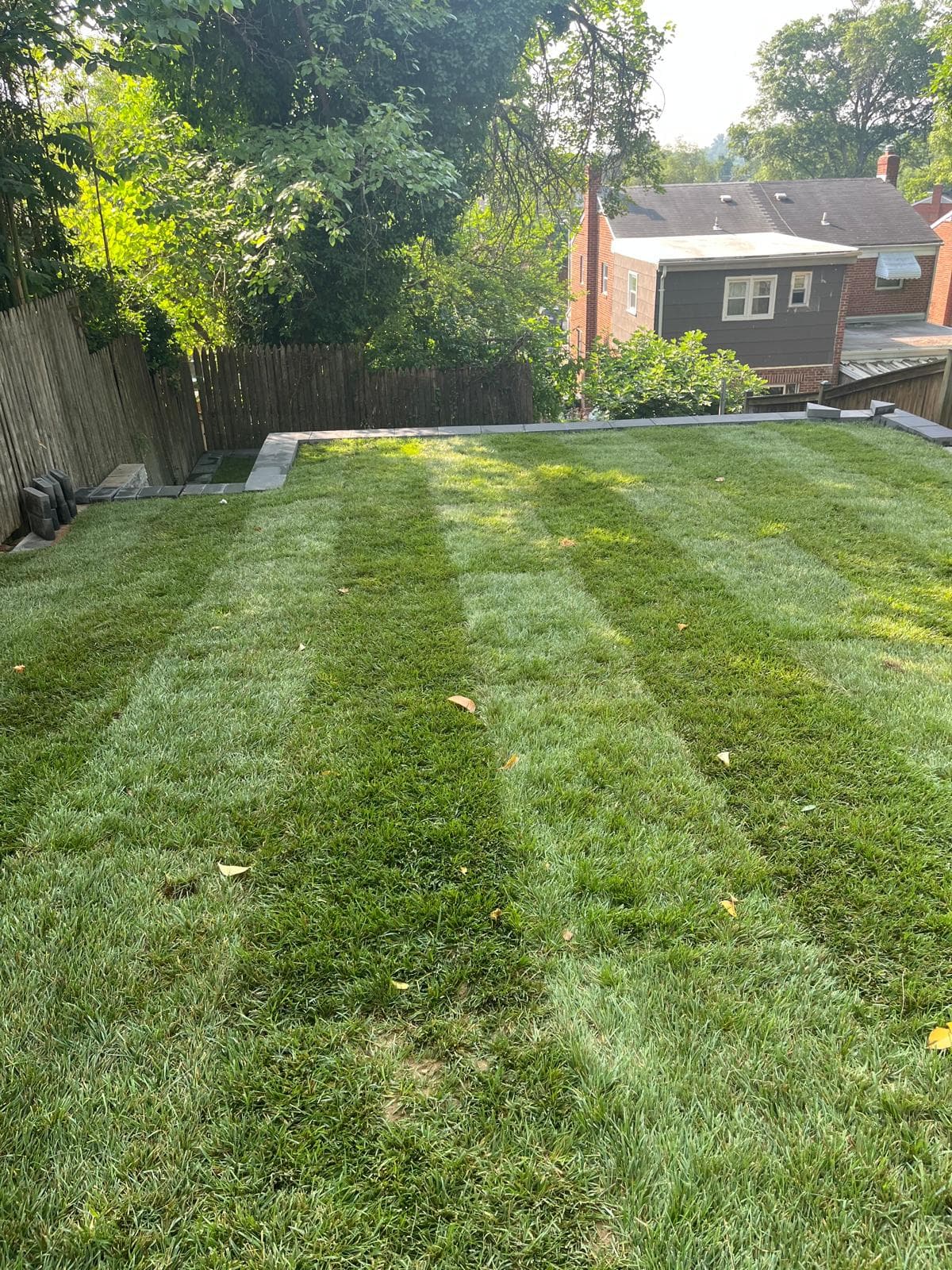
Fall lawn renovation — core aeration plus overseeding — is the single highest-ROI service a Fairfax County tall fescue lawn receives all year. Done right, the same lawn that browned and thinned through July rebounds in October thicker, greener, and more drought-resistant than it was in spring. Done wrong, the homeowner spends $400–$700 for visible plug-holes and no recovery.
This is the Kaeler 2026 playbook for aeration and overseeding in Fairfax County.
The short answer: timing + seed + post-care
| Step | When | Why |
|---|---|---|
| Soil temperature check | Last week of August | Wait until soil temps drop below 80°F at 4-inch depth |
| Core aeration | First two weeks of September | Soil moist enough to pull plugs, not so dry it cracks |
| Overseeding | Same day as aeration | Seed-to-soil contact through plug holes |
| Starter fertilizer | Same day | Phosphorus-rich, promotes root development |
| Daily light watering | First 14 days post-seed | Until germination |
| Reduce watering frequency | Days 15–30 | Force deeper roots |
| First mow at 3" | ~Day 21 | Once new growth reaches 4" |
| Fall fertilizer #2 | Mid-October | Pre-dormancy feeding |
Miss any one of these and the renovation underperforms. Get all eight right and the lawn is unrecognizable by mid-October.
Why September specifically
Tall fescue is a cool-season grass. Its biology:
- Germinates best at soil temperatures between 60°F and 75°F
- Roots aggressively when nights are cool and days are mild
- Dies in seed form if soil is below 50°F (germination stalls) or above 80°F (seed bakes before sprouting)
Fairfax County's September averages:
- Soil temp (4-inch depth, midday): 72–78°F first half / 65–70°F second half
- Air temp: 75–82°F days / 55–62°F nights
- Rainfall: ~3.5 inches across the month
This is the goldilocks window. August is too hot. October works but seedlings have less time to establish before first frost.
Specific 2-week target window for Fairfax County aeration + seed: September 7 – September 21.
For broader context on why July is so brutal on cool-season lawns, see our piece on why your lawn browns in Fairfax July heat.
Core aeration: what it is, why it matters
Core aeration uses a machine with hollow tines to pull plugs of soil (typically 0.5–0.75 inch diameter, 2–3 inches deep) from the lawn. The plugs are left on the surface to break down naturally.
What it accomplishes:
- Relieves soil compaction — Fairfax County clay compacts hard from foot traffic, mower wheels, summer heat
- Allows water + air + nutrients to reach roots — without aeration, irrigation water pools or runs off
- Creates seed-to-soil contact — overseeded seed falls into plug holes where moisture stays consistent
- Stimulates root growth — plant senses the air pocket and pushes roots outward
What it does NOT do:
- Spike aeration — solid spikes that just punch holes (no plug pulled) compresses soil sideways, makes the problem worse. Avoid contractors offering "aeration" with spike-only machines.
- Liquid aeration — sprayed product claimed to "soften soil". Marketing. Doesn't do what mechanical core aeration does.
Insist on core aeration with hollow tines pulling actual plugs.
Seed selection: tall fescue blends for NoVA
Most Fairfax County lawns are tall fescue (Festuca arundinacea). Best 2026 blend options:
| Blend | Mix | Best for | Cost (50 lb bag, 2026) |
|---|---|---|---|
| Premium tall fescue 100% | Multiple cultivars (4-Way Premium) | Best overall NoVA performance | $180 – $240 |
| Tall fescue + Kentucky bluegrass 90/10 | TF base + KBG fill | Thicker appearance, more rapid germination | $160 – $220 |
| Tall fescue + perennial ryegrass 80/20 | TF base + PR for fast green-up | Visible green within 7 days | $140 – $200 |
| Shade-tolerant TF blend | Specific shade cultivars | Yards with >50% shade canopy | $200 – $280 |
Avoid:
- Generic "lawn mix" bags from hardware stores — usually contain annual ryegrass that dies after 1 year
- Pure Kentucky bluegrass — beautiful but doesn't tolerate NoVA summer heat
- Bermuda or zoysia seed — wrong climate, won't establish
Seed rate for overseeding: 6–8 lbs per 1,000 sq ft of lawn area. A 10,000 sq ft lawn = 60–80 lbs of seed (1.5 bags). For thin lawn rejuvenation: 8 lbs/1K. For mostly-good lawn touch-up: 5–6 lbs/1K.
Starter fertilizer: phosphorus matters here
Fall lawn renovation needs a starter fertilizer applied within 24 hours of seeding. The label should read approximately:
- N-P-K ratio: 13-25-12 or similar (high middle number = high phosphorus)
- Application rate: 0.5–1 lb of P per 1,000 sq ft
Phosphorus matters because it promotes root development. Starter fertilizer with N-P-K like 24-0-12 (zero phosphorus) is wrong for new seed.
Note: Fairfax County restricts phosphorus on established lawns. Starter fertilizer for new seed has a specific exemption — pre-existing legal use. Confirm with your applicator that they have the proper Virginia certified turfgrass professional license.
Pricing in Fairfax County 2026
| Service | Typical cost (1/4 acre lawn) | Typical cost (1/2 acre lawn) |
|---|---|---|
| Core aeration only | $180 – $340 | $320 – $580 |
| Overseed only | $260 – $480 | $480 – $850 |
| Aeration + overseed + starter fertilizer (combined service) | $420 – $720 | $760 – $1,280 |
| Add: pre-aeration weed control | $90 – $160 | $160 – $280 |
| Add: post-renovation watering monitoring (1 visit/wk x 3 wks) | $180 – $280 | $250 – $400 |
For most Kaeler clients, the combined aeration + overseed + starter package is the right scope. The separate-component pricing only makes sense for very specific cases (lawn already overseeded recently, etc.).
For overall context on annualized lawn care budget, see our piece on lawn care cost per month: Fairfax vs Loudoun.
The four mistakes that waste the renovation
1. Aerating during August heat / drought
If soil temperature is above 80°F or the lawn is in deep drought, the plugs come out as compacted bricks (not loose crumbles) and seed sits on hot dry soil. Result: 30–50% germination, mostly bare lawn after 4 weeks.
Fix: Wait until late August / early September with at least 0.5 inches of rain in the prior week.
2. Mowing too short before aeration
Cutting the lawn to 1 inch right before aerating exposes crowns to direct sun, stresses already-stressed grass, and removes the protective leaf canopy that will shade germinating seed.
Fix: Mow at 3 inches in the week before aeration. Slight scalp pass to 2.5 inches the day of aeration is OK.
3. Skipping the daily watering for 14 days
New seed must stay moist (not wet) for 10–14 days during germination. Most homeowners overwater (drowning seed) or skip days (drying seed). Both kill germination.
Fix: Light watering 2–3 times per day for the first 10 days. Smart irrigation makes this easier — see our piece on smart irrigation in Northern Virginia.
4. Mowing too early or too short post-emergence
First mow should happen when new grass reaches ~4 inches. Cut to 3 inches. Cutting earlier (when grass is shorter) shocks the seedlings; cutting lower than 3 inches damages the young crowns.
Fix: Wait 21 days minimum, measure with a ruler if needed, cut at 3 inches with sharp blade.
What a Kaeler aeration + overseed visit looks like
| Step | Duration | What happens |
|---|---|---|
| Pre-visit confirmation | 24 hr before | Confirm date, weather check, irrigation status |
| Arrival + walk | 10 min | Spot any issues, confirm scope |
| Pre-aeration mow if needed | 15–20 min | Cut to 2.5" |
| Core aeration | 30–60 min | Hollow-tine machine, 2 passes for thick thatch |
| Overseed | 20 min | Calibrated spreader, two-direction pattern |
| Starter fertilizer | 10 min | Applied immediately after seed |
| Walk-through with homeowner | 10 min | Watering schedule, what to expect |
| Follow-up email | Same day | Day-by-day schedule for next 30 days |
Total time on-site for typical 1/4 acre: ~2 hours. For 1/2 acre: 3–4 hours.
Frequently asked questions
Should I aerate every year?
Yes, on clay-bound NoVA soil. Tall fescue lawns benefit from annual core aeration in September. If you're on a sandier lot (uncommon in Fairfax) every other year may be adequate.
Can I do this myself with rental equipment?
Renting an aerator from Home Depot or a local rental shop runs $80–$120/day. Plus seed + fertilizer + your time + your back. For most homeowners the combined service from a pro is roughly the same total cost but eliminates the labor + ensures proper technique. DIY makes sense for handy homeowners with smaller lots.
What about dethatching?
Tall fescue rarely needs dethatching in NoVA. Bluegrass blends sometimes do. We assess thatch depth at the site visit — if greater than 0.5 inches, we may recommend dethatching as a separate pass before aeration.
Do I water differently after aeration?
Yes. First 10–14 days: light, frequent watering (2–3 times per day, 5–10 min each). Days 15–30: reduce to once daily, longer duration. After day 30: back to regular schedule with deeper, less frequent watering.
When can I fertilize again after the renovation?
Wait 4–5 weeks. The second fall fertilization (typically mid-October to early November) uses a slow-release N-P-K like 18-0-7 to feed the established new grass before dormancy.
Will my lawn look bad immediately after aeration?
For 5–10 days, yes — plug holes visible, plug remnants on surface. By day 14–21 the new seedlings are visible. By day 30 the lawn looks thicker than it did pre-renovation. By mid-November the lawn looks dramatically better.
Ready to schedule fall renovation?
Aeration + overseed slots fill quickly in September. Book a free lawn site visit by mid-August to lock a date in the September 7–21 window.
We service lawns across Fairfax, Burke, Reston, Sterling, Vienna, McLean, and the rest of the 18 NoVA cities we serve. See all areas we serve.